
South Africa is well-known for a lot of things:
- diamonds
- wine
- amazing game parks
- Elon Musk & Charlize Theron
- And their commitment to athletics in Rugby, Cricket, Tennis, Golf, Running and even in Cycling.
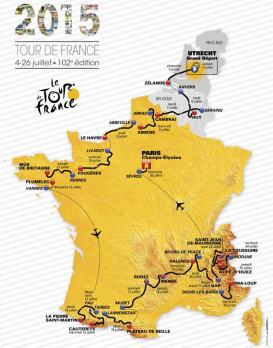
A little known secret is that until 2015 there had never been a South African team, or even an African team, registered for Le Tour de France, the most FAMOUS cycling race on Earth.
This time last year team MTN-Qhubeka, a relatively unknown team, with relatively unknown riders, got the wild card slot and became the first ever South African team to participate at this level of cycling.
As you can imagine this team was the underdog. To put it in perspective, they received a wild card entry into the Tour, they were the first ever African team to participate, and their budget was less than a third of that of their competitors, €7 million vs. allegedly over €30 million for Team Sky.
Not only was this the first team from South Africa, it was also the first ever team with black African cyclists. One of whom is Daniel Teklehaimanot. I’m pleased to inform you that from stages 6 through 10, on July 9 through Bastille Day, he held the coveted designation of King of the Mountain. An unbelievable achievement.
Less than a week later, on July 20, Mandela Day, the National Day of South Africa, Steve Cummings won stage 16. Absolutely incredible.
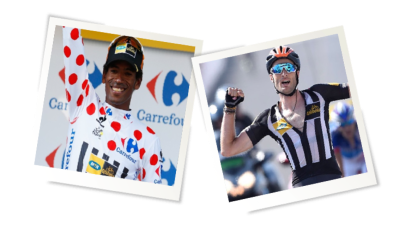
- Daniel Teklehaimanot & Steve Cummings
How could such a thing happen? What had changed? What would make an upstart team, a wild card with unknown riders and less than a third of their competitor’s budget achieve designations in 25% of the stages?
That year the sport of cycling was disrupted by the digital revolution.
To understand what happened, let’s take a walk back in time, not too far back, only as far as 2014.
Those who follow cycling know that success in this sport is the cross-section of Strength, Strategy & Science.
Strength, is the natural ability of each of the racers, their fierceness to compete, their commitment to train and drive.
Strategy, is the art of the race. When you watch competitive cyclists, you will notice that they ride in groups. These groups are called a peloton. They ride in that formation so that racers at the front of the group may block the elements allowing the riders behind them to leverage the physics of drafting and save their strength for when they split off. Eventually you will see riders split off into breakaway groups and race to the finish.
Science, is knowing when to breakaway, and once you have done so, knowing how fast and hard you have to ride to maintain your lead. As you can imagine, knowing the distance, speed and acceleration of the peloton behind you is critical. To help riders assess that information, they measure the time gap.
Until 2014, the way to measure a time gap, was for two people on the back of a motorcycle to carefully ride up as close as they can to the last rider of the breakaway group and, using the speed of the motorcycle, they predicted the speed of the bikers. They would then stop the motorcycle, start a stop watch, and measure the time it took for the peloton to catch up. Once they had the data, they would do simple arithmetic and use a radio to transmit the information to the comaisar’s car, who would then publish it to the media, fans and most importantly the teams supporting the cyclists. Then the most unbelievable thing happened, the person on the back of the bike took out a piece of chalk, and wrote down the information on a chalk board, then rode up to the cyclists to show them the time gap and speed.
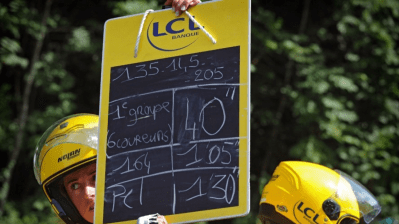
- time gaps
As you can imagine, this snap shot in time, has a very short shelf life. The moment they left the last rider of the breakaway group the speed would have changed. The moment they clicked off the stop watch, the speed and distance of the peloton would also have changed. The data was indicative at best and mostly irrelevant.
You’re probably asking yourself, are we still speaking about 2014? In this day and age, with the technology we have, how is this possible? How come we cannot receive this data in real time?
Well, it turns out the devices we use are ONLY receivers and cannot transmit data, more especially in areas where there are no mobile services.
Fast forward to around this time last year, not even 12 months ago, for the first time ever Dimension Data, and partners, developed a set of telematics devices that could now tell us the location of every rider, their altitude, the number of heart beats and pulse. With this data, we could now measure the biker’s speed, velocity, heart rate and pulse. All in real time, anywhere in the world, amazing.
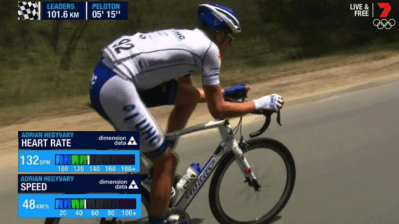
This technology has fundamentally changed the landscape of Cycling. With the right data, at the right place, at the right time, knowing when to break away and how much harder you have to compete to keep the lead is now based on science. It should be no surprise that bikers like Daniel & Steve can now leverage this data into knowledge and competitive advantage.
For me the digital transformation we are seeing around us is terrific. With one click of a button, you have an infinite amount of data about most things. But it is important to note, that in the same way that before digitization, data could provide the wrong indication because it was not current, in today’s environment with the explosion of data, it becomes more important to understand and build the processes for you to start to separate the signal from the noise. It becomes very important for you to figure out how you can turn the data you require into information and information into knowledge that will help you achieve your goals.
We need to learn to manage our data. We must normalize and categorize it into information, and then couple it with intelligence to turn it into Knowledge, into Evidence that will help us decide where we are and where we need to go.
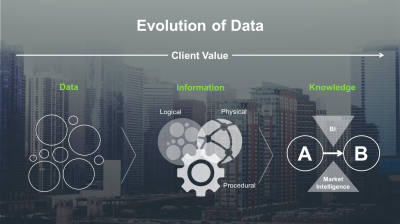
- evolution of data into knowledge
Today, cyclists know their location and heart beats, which are normalized and categorized into information about their speed, elevation and heart rate. Once this information is combined with the location of their competition and the terrain ahead, they could now create the Knowledge, the Evidence they needed, to execute on their plan and know when to break away and create competitive advantage. It is no surprise that riders like Daniel & Steve, and teams like MTN-Qhubeka, are able to achieve outstanding results.
EVIDENCE MATTERS
Join us every week for thoughts about how to manage data into knowledge, the risks of not using the right data, and a FACTS based decision-making framework.
 Transforming Insights into Action
You must be logged in to post a comment.